Hello folks, Mark here:
Maybe it is just me, but it seems like there is just a whole lot of 'noise' going on right now in the 'real' world, the publishing world, the convention world--practically every sphere of life as I see it has individuals or groups screeching support or invective about something.
Frankly, it is getting so loud on so many fronts that I fear the din will keep me from my words. I have a novel to edit/revise, and a fourth one to finish planning and execute. And yet everywhere I turn its political cess-pool this, Russia in the Crimea, bodies in Syria, knife attacks in China, and various boycotts of convention toast masters, genre publications and nominating judges for SFF awards that...
And we wonder why we fall prey to cynicism.
When the world gets like this, one could argue that it is ALWAYS like this and just our awareness changes, then I find myself looking for a project or a book to help quiet the roar, so to speak.
I try to escape into the silence of another mind as means to get myself back on track. For some folks its meditation, others rely on faith driven tracts, and still others go for music. I've used all three at various times in my life, and yet as I trundle along, spending the decades of my middle years, I find I resort to books and certain authors the most. Cornwell's feaux history Sharpe novels work for me. Tolkien has always been an anchor. There is something about a good wallow in the dust and reek of middle earth that leaves me feeling clean and ennobled. I do quite well with LeGuin's take on dragons and magic to reset my equilibrium.
But when I want silence I always go back to McKillip, and it doesn't matter much which novel or novels. I always find nuances of that poetic pause that shows me her mind, how it works, how she sees her imagined worlds. Reading her is to take a journey into the intimate. I'm dabbling with The Bards of Bone Plain and The Forgotten Beasts of Eld right now. I've come to appreciate how much cooking goes on in McKillip's stories. Bards is one of her latest, Beasts her first, and the motif stands up nicely. There is something about a well peeled carrot that speaks of non-thinking-being, an important part of a character's real flesh, as it were. Silence sits on the pages of her prose like a cat, poised and regal, assumes control of the window ledge.
And I don't refer to the narrow scope she places on her characters. To me, she writes "quiet" prose, much like LeGuin, that allows us to breathe in the syllables. I never suffer sensory overload when I read her stuff. When the pace of the world gets too much, I go back to McKillip. Who do you go to?
Mark Nelson

Monday, March 17, 2014


Thursday, March 13, 2014
Thursday Review: Night's Master by Tanith Lee
In my last review I picked a collection of classic pulp stories from the 30s that had a female protagonist and were co-written by a female author. So I thought I'd continue the female author theme but move on somewhat in time to the 70s and Tanith Lee's Night's Master.
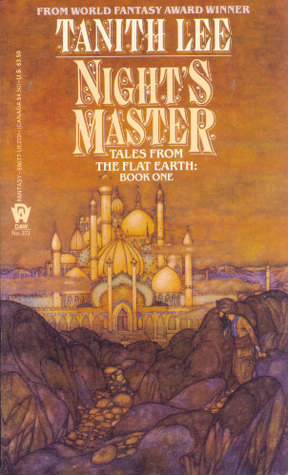
Often described as being reminiscent of One Thousand and One Nights, probably because of the vaguely Middle-Eastern setting and because of the rather amusing sexual incidents which crop up from time to time, Night's Master is in many ways superior to that classic. it has a strong undercurrent of amorality and dark humour, reasonably so since the chief protagonist is a demon, but is also very sensual in its language. In fact I thought it a bit like By Grand Central Station, I Sat Down and Wept without the emotional baggage, but the same kind of power evoked by the choice of words.
It's a collection of short stories that are linked by characters and an artefact and end up being also a coherent novel in itself. A goodly length but certainly not one of the vast fantasy tomes which the late 70s began to throw up and continue to be regurgitated to this day (admittedly sometimes quite tastily at first).
Here's the first edition US cover, which does actually depict a scene from the book; quite unusual I think for a 70s cover, though it does manage to utterly fail to capture the spirit of the work:

A flat earth where the gods are bored of mortal doings, if they were ever interested, and the demon Azhrarn amuses himself at mortal expense. This book has almost everything that could seriously upset some readers: homosexuality, bestiality (hugely amusing as a way to get past a rather fearsome guardian of treasure), acts of utterly callous cruelty, unrepentant sororicide and so forth, all delivered with a passionate prose which is never less than beautiful. Almost everything is driven by some kind of vice: lust, avarice, jealousy. There are few admirable characters lurking within these pages, and mostly those that are do not prosper.
Without question one of the very best fantasies I have ever read. Miles better than the more famous contemporary works of Moorcock (Elric) or Donaldson (Thos. Covenant) and yet, despite having like those others spawned a considerable series with the same setting, somehow less famous.
There is an audio version available from Audible, which I would wholeheartedly recommend. The narrator's manner is somewhat 'bedtime story', which is, I think, deliberate, and certainly increases the humour of many passages without detracting from the essential beauty of the words.
Go and buy it now.
review by David Hunter
Monday, March 10, 2014
A Toast to the Lassies
Greetings, everyone! I’m Louise
Turner, my debut historical novel Fire and Sword was published by Hadley
Rille Books last September, and I’ll be co-ordinating the HoF blog throughout
March and April, so don’t be surprised if there’s a distinct bias towards
historical fiction and matters historical over the next couple of months!
I thought
I’d kick off with one of the major challenges confronting
writers of historical fiction: how to write strong female
characters who can resonate with a modern audience and yet remain true to their own time. I'll be concentrating on Western Europe in the late medieval period, mainly because my own novel’s set in late 15th
century Scotland, so that's where my research has been strongest to date. And if you're looking for some accompanying reading matter, can I suggest for starters, Medieval Women: A Social History of Women in England 450-1500 by Henrietta Leyser (Phoenix Giant, 1995) because it's an excellent introduction!
It’s fair
to say that society across much of Europe in the late medieval period was deeply misogynistic. Mistrust of women was deeply rooted in the
Catholic church, with women traditionally blamed for the concept of original
sin. Even the ancient Classical texts that circulated in the wake of the
Renaissance brought scant improvement: in medical terms, women were viewed as
imperfect men, their reproductive organs improperly developed versions of their
male counterparts. Women were dominated
by cold humours and they constantly sought the ‘heat’ of men (through sexual activity) to warm them. Their womb was prone to wandering throughout
the body, producing all manner of disorders –pregnancy was beneficial because
it anchored the womb in one place which in turn kept the woman healthy and – dare I
say it – settled in mind.
This kind
of thinking helped maintain a moral framework that put men firmly in control. With
God occupying the position of ultimate authority, the heavenly hierarchy was replicated
on earth in both the ecclesiastical and the secular worlds and also in the
domestic sphere. Here the man was viewed as the ‘head’ of the household, with
the woman taking a subservient, unquestioning role. This was the natural
order. To argue otherwise was to pervert
Nature, to overthrow God’s plan for the world/universe.
 |
| Sir Geoffry Luttrell's Wife & Daughter-in-Law Present Him With Helmet & Shield As He Rides to War (Mid-14th Century) |
Does this
mean, then, that women were devoid of power and influence? They were certainly encouraged
to be meek, and mild, with the Virgin Mary put forward as a suitable role
model. But I don’t think a weak,
ineffectual woman would have been much in demand as either a wife, or a mother.
I’m sure women were more than capable of wielding real power in the domestic
sphere, and I’m also sure that most women were savvy enough to manipulate their
situation to suit their own ends. To be seen to wield power and authority may
have been socially unacceptable, but even then it might have been more common
than might be assumed. If the medieval stereotypes
of the domineering woman – the scold and the shrew- hadn’t been familiar to medieval
audiences, then I don’t think they would be quite so heavily featured in
contemporary literature.
 |
| Women Assaults Man With A Distaff (Luttrell Psalter - Mid 14th Century) |
In my
attempts to recreate real medieval women, I’ve tried not to write women ahead
of their time. Their strength is quiet, their influence subtle. But they are
strong nonetheless and their influence cannot be underestimated. Modern women like me
owe women like these who lived in the historic past (and indeed the prehistoric past!) a great deal, because if it hadn’t been
for their efforts to push back the boundaries and constraints of their world and to improve both their own lives and the lives of the generations who followed after them, we wouldn’t be where we are today!
Images derive from the Luttrell Psalter, Held by the British Library and Discussed in Detail in 'The World of The Luttrell Psalter' by Michelle P. Brown (British Library, 2006)
Wednesday, March 5, 2014
Wednesday Review: Bad Bishop

Genre: Fantasy
Price: $14.53 paperback or $3.50 Kindle
Publisher: Safkhet Fantasy
ISBN: 1908208171
Available from: Amazon and Barnes and Noble
Book description
History is not something that happened to other people. History is a memory. August A.D. 1120 Dijon. A headless corpse is found in a room with shuttered windows and the door locked from the inside. The man's name was Salonius and he was the Duke. His young heir's grasp on the throne is precarious, yet a new alliance is made to safeguard his position. November A.D. 1120 Barcelona. Alexander, the Prince, learns that the emperor Enmerkar is looking to add Barcelona to his territories. January A.D. 1121 London. Julian, the Governor, finds that Enmerkar has turned his hungry gaze toward England. April A.D. 1121 York. Medb, the Queen, discovers that Enmerkar hungers for the whole Isle. Many now recognize the threat posed by Enmerkar's continued expansion, so a game of politics begins to spin a web of alliances and treaties that will thwart Enmerkar. But this is not a web of humankind. These men and women are Algul, a race that lives, unseen, alongside humanity. They are rulers and warriors, storytellers and shapeshifters, magicians and politicians. Each was human once. None is human now. Their learning is far deeper than that of humans, their strength far greater, their lives not curtailed by illness or by age - the price a life lived in the shadows and sustained by blood. Yet while all others are entangled in their political machinations, only one man can see that Salonius's murder was but the first move in a deeper plot, one that even he cannot fully piece together. For, in a world where history is a memory, the greatest danger comes from what has been forgotten.
Good morning! It's Cybelle here again with my second book review on HoF. This week, I enjoyed reading Irene Soldatos' novel, Bad Bishop. The main characters are essentially a vampiric race, the Algul, whose elders carry memories of more enlightened times and bemoan the ignorance of the medieval world. The main heroine, Amarante, an erudite young widow, is offered the chance to live forever as a member of the House of Atreus. Each Algul has unique powers, and Amarante discovers that hers include power over the weather, the same talent her ancient progenitor, Atreus, possesses. Her "father," Kyrus, also selected for his scholarly acumen, has power over the land and other physical elements. For the most part, members of this Genus are content to devote themselves to solitary, academic pursuits, but the murder of the Duke draws all of them into a dangerous intrigue, which plays out like a chess game.
As a classicist, I found many things to love about Bad Bishop, not the least of which was the use of Latin, Greek, medieval French, and Celtic languages interspersed throughout the book. The author does an excellent job of creating an alternate medieval world, inhabited by a variety of peoples whose languages and culture are in a state of flux. The amount of research that Soldatos must have put into this work is admirable. She also creates some wonderful female characters, both human and Algul, who find find ways around societal constraints placed on women. The scholarly interests of the main characters also remind the reader how precarious the survival of ancient literature was during that time. Books were costly and time consuming to produce; only a handful of individuals had access to the knowledge they contained.
On the negative side, the first few chapters could have been a little more engaging. The back story, while interesting, felt distant, and the language was rather repetitive. In a few places, the grammar was also a bit off, which broke the spell of the narrative from time to time. However, the overall concept is brilliant, and a few chapters in, I was hooked. It's well worth reading but does require concentration!
Monday, March 3, 2014
Sacrificing character for plot
I wrote my post Books That Linger back in January. One of the books I cited was Ender's Game. I recently watched the movie version of it and was disappointed. I thought perhaps it is because I just finished reading the book, but no--that wasn't it.
I try to watch movies as movies, even if they were once books I loved. They are totally different beasties. I thought Hunger Games was well done as a movie. Certainly, there were sacrifices, but they didn't detract from an enjoyable movie; that seems to be the consensus of those I know who've both seen and read the story. Ender's Game? Not so much. Too much characterization was sacrificed for plot, and the plot suffered for it. All that made Ender's Game a great story was diluted out. We feel for Ender in the book because we KNOW Ender. We feel his pain, his fear, his frustration because Mr. Card provided us with all we needed to do so. On the screen, having the immensely talented Asa Butterfield teary-eyed for most of the film just didn't cut it.
And that brings me to the crux of my post--sacrificing character for plot. Some of the big books do it. Not to pick on Mr. Martin again, though we seem to do so in this blog, but I've been feeling this a lot in the Song of Ice and Fire series. In the early books, the characters drove the plot along. The further in we get, the more characters we are faced with, the less defined they become. It gets harder to feel for them, even if we have in the past.
I have been working on The Shadows One Walks, fourth in my cycle, for a little over a year now. Though a reader can read any of my books without having to have read the others, they all connect in some way. With The Shadows One Walks, the reader needs to have read the other books for it to really pack its punch. Threads from Finder, A Time Never Lived, and Beyond the Gate get woven together in the fourth book. As I work through it, I'm trying to keep those threads from tangling, making sure they get tied into satisfying knots. The plot feels much bigger, and it is...and that's been the problem.
My stories are very much about the characters. As one reviewer put it, I write about the little people in big worlds. It's not about the big events, it's about the people living through them. In The Shadows One Walks, I discovered I'd been sacrificing the heart of my story--its characters--for a big plot that I never meant to write.
It's not the first time I've done this. When writing A Time Never Lived, I did the same thing. I went down the path of "political intrigue" when the story was supposed to be about a young man's search for his father, about love against the odds, and about how we are all, at the core, from the same stuff. I ended up ditching about thirty thousand words of first draft and starting at the beginning again, this time treading the right path--the character path.
I won't have to do that with The Shadows One Walks, but I do have to make adjustments--big adjustments. Such is the life of a writer. Yet it gets me wondering if movie-makers discover they've drained the story's characters from their films, and still choose to sacrifice them for bigger boom-pow-shebang plots. And authors whose stories get away from them, whose plots get so big that the characters become almost interchangeable.
So the big question is, can you forgive a weak plot for great characters? Or can you forgive weak characters for a great plot? Either? Neither? Both?
For me? I'd naturally prefer getting both great characters and a great plot, but if I had to choose, I'll choose characters every time. What about you?
Curious oysters everywhere want to know.
I try to watch movies as movies, even if they were once books I loved. They are totally different beasties. I thought Hunger Games was well done as a movie. Certainly, there were sacrifices, but they didn't detract from an enjoyable movie; that seems to be the consensus of those I know who've both seen and read the story. Ender's Game? Not so much. Too much characterization was sacrificed for plot, and the plot suffered for it. All that made Ender's Game a great story was diluted out. We feel for Ender in the book because we KNOW Ender. We feel his pain, his fear, his frustration because Mr. Card provided us with all we needed to do so. On the screen, having the immensely talented Asa Butterfield teary-eyed for most of the film just didn't cut it.
And that brings me to the crux of my post--sacrificing character for plot. Some of the big books do it. Not to pick on Mr. Martin again, though we seem to do so in this blog, but I've been feeling this a lot in the Song of Ice and Fire series. In the early books, the characters drove the plot along. The further in we get, the more characters we are faced with, the less defined they become. It gets harder to feel for them, even if we have in the past.
I have been working on The Shadows One Walks, fourth in my cycle, for a little over a year now. Though a reader can read any of my books without having to have read the others, they all connect in some way. With The Shadows One Walks, the reader needs to have read the other books for it to really pack its punch. Threads from Finder, A Time Never Lived, and Beyond the Gate get woven together in the fourth book. As I work through it, I'm trying to keep those threads from tangling, making sure they get tied into satisfying knots. The plot feels much bigger, and it is...and that's been the problem.
My stories are very much about the characters. As one reviewer put it, I write about the little people in big worlds. It's not about the big events, it's about the people living through them. In The Shadows One Walks, I discovered I'd been sacrificing the heart of my story--its characters--for a big plot that I never meant to write.
It's not the first time I've done this. When writing A Time Never Lived, I did the same thing. I went down the path of "political intrigue" when the story was supposed to be about a young man's search for his father, about love against the odds, and about how we are all, at the core, from the same stuff. I ended up ditching about thirty thousand words of first draft and starting at the beginning again, this time treading the right path--the character path.
I won't have to do that with The Shadows One Walks, but I do have to make adjustments--big adjustments. Such is the life of a writer. Yet it gets me wondering if movie-makers discover they've drained the story's characters from their films, and still choose to sacrifice them for bigger boom-pow-shebang plots. And authors whose stories get away from them, whose plots get so big that the characters become almost interchangeable.
So the big question is, can you forgive a weak plot for great characters? Or can you forgive weak characters for a great plot? Either? Neither? Both?
For me? I'd naturally prefer getting both great characters and a great plot, but if I had to choose, I'll choose characters every time. What about you?
Curious oysters everywhere want to know.
Wednesday, February 26, 2014
Wednesday Review - The Black Orb
Good morning, everyone! I'm Claire Ashgrove (or Tori, or Sophia, or pick a name, any name), and I'm very happy to be contributing to reviews on the 4th Wednesday of even months. As an author and editor who’s incredibly supportive of the independent market, when I was asked to review for Heroines of Fantasy, I decided I was going to start out with independently published and small press published books. If we’re on the search for gems, you don’t need me providing remarks on a book that’s already amassed accolades or has countless reviews floating around. Which leads me to today’s review of The Black Orb.

THE BLACK ORB
Author:Sabine A. Reed
Genre: Fantasy
Price: $1.99 (ebook)
Publisher: Sabine A. Reed
ASIN: B00FFDTZKS
Price: $1.99 (ebook)
Publisher: Sabine A. Reed
ASIN: B00FFDTZKS
An accomplished thief, Aria runs cons and picks pocket so that she can support her older brother, who is one of nature’s innocents. When he disappears, she fears he has been abducted by the minions of the Queen of Azmeer, and forcefully recruited in her army. While seeking word of his fate, she narrowly escapes capture herself. She is aided by an old man who appears to have strange and magical powers. Bikkar claims to know how she can free her brother and at the same time defeat the Queen’s potent weapon, the Black Orb, which sucks power from mages.
But before they do that, Bikkar must escape the stone warriors who pursue him, and Aria must die, for no living person can wield the magical Dragon Claw.
The Remarkables:
I love this cover. It’s intriguing, it’s certainly professional, and perfectly conveys fantasy. Self-publishing authors, take note. Way. Awesome. Cover!
The magical elements are very intriguing and unique. And the negative and positive consequences of these are also interesting. The device that resolves the conflict, the Dragon Claw, its origin, ability, and how it’s employed is very original.
There’s also a secondary character, the heroine’s brother, who was a breath of fresh air. He’s “slow” as the heroine describes him, and typically characters like this are recluses and usually stand offs. This one is well loved, and it was very nice to see him with a devoted partner as opposed to being the isolated, pitiable character we commonly see.
Overall concept of the book is also really engaging, and there are elements to the world building that are inspired—such as the Dryad’s and the way they are tied into the forest. Traditional, and yet not. Very nicely done.
Presentation is above average, wholly professional, and it’s clear the author has employed professionals to meet this expectation. Good job!
The Not-so-remarkables:
While the story was interesting, it just wasn’t as captivating as I had hoped it would be. It’s entertaining, but it isn’t mesmerizing.
I found the heroine a bit over the top – she never failed at anything, pulled off some miraculous deeds, achieved “legendary status” with little work, and pretty much was guaranteed to achieve her goal. I never felt like she was ever in danger, and that breathless, hanging-on-the-edge tension just wasn’t present. She’s too belligerent at times, too snarky, lacked internal struggle, and jumped too readily into her circumstances for her background. I like more tension, more conflict both internally and externally. I like more of a true journey of the soul, where values and beliefs are tested.
It wasn’t a bad book by any means. But as a professional editor who has worked with a multitude of books, what was most disappointing is the potential that’s right there but just not quite making it to the page in the right areas. Perhaps this is a result of this being a somewhat older book of the author’s, and in all fairness, I must mention that. Honestly, I don’t fault the author at all; a solid developmental editor should have pulled those aspects out, and I’m saddened this didn’t occur.
I think overall, I can sum up my thoughts with it was a good, enjoyable read, but I expected great, and was disappointed by the fact it could have been exceptional with a little more depth. If you’re looking for a short entertaining passing of time, pick it up and check it out. If you’re looking for a read that will keep you on the edge of your seat, I don’t make the recommendation.
~Claire
Monday, February 24, 2014
Words Matter
This week's guest poster is Irene Soldatos, author of the newly published Bad Bishop. Take it away, Irene!

In terms of the equality of the sexes, our society seems to be hovering somewhere between stage two and three – and has been doing so for some time. These days, western society generally accepts that the sexes are equal; not only that they should be treated as though they were equal, but that they are equal, and that societal behaviour should reflect this.
This acceptance was arrived at slowly,
and it involved a great deal of argument, philosophical and otherwise, because
after all there has been millennia of social conditioning to contend with; but
eventually certain things were accepted, and as such acceptable modes of
behaviour were agreed upon. For example: An employer may no longer fire a woman
for being pregnant. Hurrah! A result! While this became enshrined in
legislation, however, it was still perfectly common and acceptable, to call
women ‘sweetheart’ at work, and ‘flirt’ outrageously with them.
Eventually, the ‘flirting’ came to be called harassment, and that was put a stop to, though the ‘sweetheart’ endured for a while longer, because, after all, it’s just a word; it doesn’t hurt anyone; it’s a term of endearment after all, what can possibly be wrong with addressing women in such an amicable manner?
By now, of course, the year being 2014, using the word ‘sweetheart’ in the workplace is not really the done thing, because it’s finally been pointed out that men don’t call each other ‘sweetheart’, or ‘darling’, or ‘my dear’, so why should they do so with women who are not their romantic partners or their wives? The fact is, words carry meaning. A shocking revelation, I know; but true. Imagine a man addressing his male colleague, or subordinate, as ‘sweetheart’. Or telling him he looked very nice today. You’ve done something with your hair. Is that a new suit?
Words carry meaning and reflect thoughts – and modes of thought. And that’s what the problem with ‘sweetheart’ is. So, now we’re at the point where certain modes of expression towards women have become taboo, and that goes a long way to making the environment in which half the human population lives (at least in Western secular societies) a bit less unpleasant than it was previously. However, just because a word is not used, it does not go to mean that the thought or mental attitude that would prompt you to use it is gone too. It only means that you censor yourself to comply with acceptable social norms.
Given time, though, the changes in the way we express ourselves will lead to changes in our thoughts and mental attitudes, because words condition our thoughts, just like our thoughts are reflected in our words. In fact, thought and language are inextricably linked: we can only contemplate abstract concepts using words, and words define the concepts themselves. Simply changing the word we use to describe a certain act is enough to change the act itself from acceptable to unacceptable. It changes the way we think about it. This is what has happened since we replaced the word ‘flirting’ with ‘harassment’. Now what I would really like to see go the way of the dodo is the tendency to say to little girls, the moment people meet one: ‘What a pretty girl you are!’ Why don’t people say that to little boys? Why don’t they say: ‘What a good-looking boy you are!’? Because the appearance of boys is not important, presumably, whereas the appearance of girls is. And this is how women, and men, learn from infancy that it’s the most important thing – for women. Because words carry meaning.
The fact is, all we know is what we have words
for. As Wittgenstein very rightly said: ‘The limits of my language mean the
limits of my world.’
So it logically follows: What we say,
and what we write, even in fiction, plays a part in forming the world we live
in. It matters.
~Irene Soldatos
I was born in Greece, but growing up lived in England. Then in Greece. Then in England again. Then in Germany. Now I'm back in England. I get about. I have a B.A. in English and a Master’s and PhD in Musicology. I’m a geek, a dedicated pen-and-paper gamer, and a vocal advocate of all things Open Source, and non-commercial sharing.
You can find Irene at:
website
Facebook
Twitter
~Irene Soldatos
I was born in Greece, but growing up lived in England. Then in Greece. Then in England again. Then in Germany. Now I'm back in England. I get about. I have a B.A. in English and a Master’s and PhD in Musicology. I’m a geek, a dedicated pen-and-paper gamer, and a vocal advocate of all things Open Source, and non-commercial sharing.
You can find Irene at:
website
 |
| Available on Amazon |
Subscribe to:
Posts (Atom)